

Ever wonder how complex metal parts in your car, phone, or medical devices are made with millimeter precision? The answer lies in CNC (Computer Numerical Control) machines-sophisticated tools transforming digital designs into physical objects. But what makes these machines tick? Let's break down their core components and why they're revolutionizing factories worldwide.
🔑 The 5 Core Parts of Every CNC Machine
While designs vary, all CNC machines share these fundamental subsystems:
Information Carriers
The "brain" of the operation. This is where machining instructions (like tool paths and cutting speeds) are stored. Think punched tapes, USB drives, or direct computer inputs . Modern machines often use cloud-based programs, allowing real-time updates from engineers' laptops.
CNC Control Unit
This component translates stored instructions into action. It includes:
Input devices (keyboards, touchscreens)
Central processor (the "decision-maker")
Output systems that send commands to motors .
Fun fact: This unit uses the same Cartesian coordinate system (X, Y, Z axes) as your high-school math class to map movements!
Servo Drive Systems
The "muscles" moving the machine. Servo motors (AC, DC, or stepper types) spin cutting tools or adjust worktables. Power amplifiers boost signals from the control unit, ensuring precise force application . Pro tip: Stepper motors offer affordability, while servo motors deliver higher precision for aerospace parts.
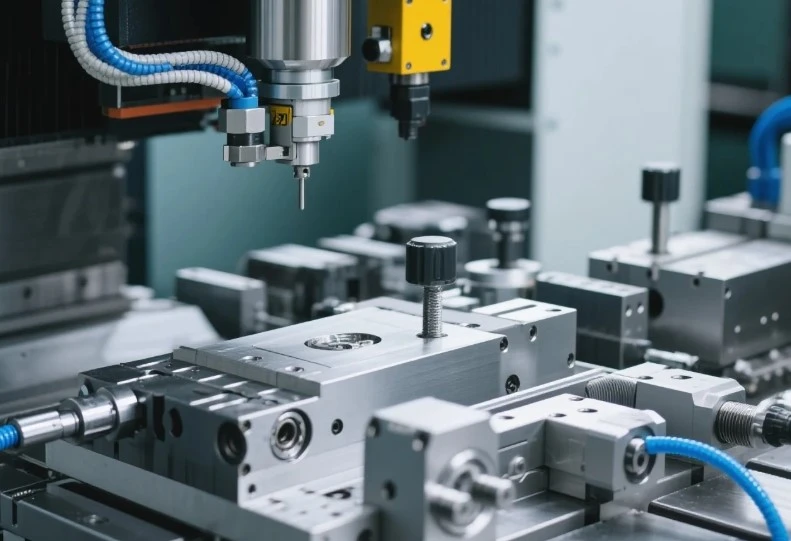
Measurement Feedback Devices
CNC machines constantly self-correct using sensors like:
Rotary encoders (tracking spindle rotation)
Grating scales (measuring linear movement)
Magnetic scales (detecting position shifts) .
This real-time feedback creates a closed-loop system-crucial for cutting titanium engine components within 0.001-inch tolerances.
Machine Body & Mechanics
The heavyweight champion! This includes:
Bed/Frame: Shock-absorbing foundation
Spindle: High-RPM cutting tool holder
Feed mechanisms: Ballscrews/rails guiding movements .
Modern trend: Advanced materials like polymer-concrete composites reduce vibration for smoother cuts.
⚙️ Control Systems: Precision Matters!
Not all CNC machines operate the same. Their control style impacts accuracy and cost:
Open-Loop: Budget-friendly, ideal for woodworking. No position sensors-commands run without feedback .
Closed-Loop: For precision metalwork. Uses sensors to correct errors instantly .
Semi-Closed: Balances cost and accuracy. Measures motor rotation instead of tool position .
🛠️ Why These Parts Matter in Real-World Manufacturing
Automation: CNC devices handle tasks like tool changes and coolant flow via Programmable Logic Controllers (PLCs), slashing human error .
Versatility: Swap a program-not hardware-to shift from milling aluminum to carving carbon fiber.
Challenges: High upfront costs (50k–50k–500k) and skilled maintenance needs remain hurdles .
🔮 Future Trends: Smarter, Greener Machines
The latest CNC innovations focus on:
AI Integration: Algorithms predicting tool wear before failures occur .
IoT Sensors: Live monitoring of power use, temperature, and vibrations via cloud dashboards .
Sustainability: Energy-efficient motors and recyclable coolants cutting waste by 30%+ .
💡 Maintenance Pro Tip
Keep servo motors and feedback sensors clean! Dust buildup causes 23% of CNC errors . Schedule quarterly calibrations using laser alignment tools.
Wrapping Up
From information carriers to servo drives, each CNC component transforms code into physical reality. As automation surges, these machines will keep driving efficiency in aerospace, medical, and consumer tech. Got a CNC project? Prioritize closed-loop systems and IoT-ready models!
"CNC machining isn't just about cutting metal-it's about sculpting innovation." – Advanced Manufacturing Digest, 2025