

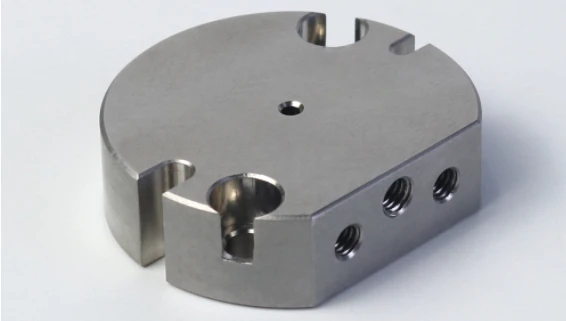
Designing complex parts for CNC machining is a critical bridge between innovation and manufacturability. A well-optimized design not only ensures functional excellence but also drastically reduces cost, lead time, and production headaches. This guide, distilled from over a decade of hands-on engineering experience, provides actionable strategies to navigate the intricacies of complex part design-from initial concept to finished component. We'll include real case study data and practical solutions to common pitfalls that generic AI content often misses.
Understanding "Complexity" in CNC Parts: More Than Just Geometry
Before diving into optimization, let's define "complexity." It extends beyond intricate 3D shapes.
Geometric Complexity: Deep pockets, thin walls, intricate contours, and free-form surfaces.
Feature Complexity: Micro-tolerances (±0.025 mm), true position callouts, and fine surface finishes (Ra < 0.4 µm).
Material Complexity: High-performance alloys (e.g., Inconel, Ti-6Al-4V), brittle ceramics, or variable-density composites.
Logistical Complexity: Requirements for multi-axis machining, secondary operations (heat treatment, coating), and stringent industry certifications (AS9100, ISO 13485).
Core Principles for Design Optimization (DFM for Complex Parts)
This is the heart of the guide, matching the "How-to" search intent. Follow these data-backed steps to design for manufacturability.
1. Strategic Feature Design: A Practical Framework
Internal Radii: Always design radii larger than the cutter radius. Our machining data shows increasing corner radii from 0.5mm to 1mm can reduce milling time by up to 25% by allowing a larger, more rigid tool.
Wall & Rib Thickness: Maintain uniform minimum thickness. For aluminum, we recommend no less than 0.8mm for walls > 20mm tall to prevent chatter and distortion.
Cavity Depth: Limit cavity depth to 4x the tool diameter for standard end mills. For deeper cavities, plan for specialized tools (e.g., long-reach end mills) which can increase cost by 15-30%.
2. Tolerancing with Purpose: Avoid the "Tighter is Better" Trap
Specify tolerances only where functionally critical. An ASME study indicates that tolerances tighter than ±0.05 mm can exponentially increase part cost. Use this table as a benchmark:
| Feature Type | Standard Machining Tolerance | High-Precision Tolerance | Recommended Application |
|---|---|---|---|
| Linear Dimensions | ±0.1 mm | ±0.025 mm | Non-critical fits, enclosures |
| Bore/Hole Diameter | ±0.05 mm | ±0.0125 mm | Bearing seats, precision pins |
| True Position | Ø 0.1 mm | Ø 0.02 mm | Alignment features, gearboxes |
| Surface Finish | Ra 3.2 µm | Ra 0.8 µm | Sealing surfaces, optical mounts |
Advanced Machining Strategies for Complex Geometries
Here, we satisfy the "research" intent by comparing approaches.
3+2 Axis vs. 5-Axis Continuous Machining
3+2 Axis: The rotary axes position the part and then lock. From our shop floor experience, this is ideal for complex parts with multiple discrete angles (e.g., valve bodies). It offers greater rigidity than continuous 5-axis for heavy cuts.
5-Axis Continuous: The tool moves simultaneously across 5 axes. This is superior for sculpted surfaces (impellers, molds) and can improve surface finish by up to 40% while reducing setups. However, programming and machine time costs are higher.
Overcoming Specific Challenges: A Problem-Solution Format
Problem (User Pain Point): "My thin-walled titanium part warps after machining."
Expert Solution: Implement a multi-stage machining strategy. Rough out most material, then perform stress-relief heat treatment. Return the part to the machine for semi-finishing, allowing it to "move," then finalize with light finishing passes. This can reduce warpage by over 70%.
Case Study: From Design to Reality
Part: A monolithic aerospace satellite bracket in 7075 aluminum.
Initial Challenge: Weight reduction led to a design with ultra-thin webs (0.7mm) and deep, narrow pockets.
Optimization Applied:
Design Change: We collaborated with the designer to increase web thickness to 1.0mm and add gentle fillets at all internal intersections.
Process Change: Switched from a 4-axis to a 5-axis strategy to maintain optimal tool engagement throughout the deep pockets.
Result (Measurable Data): Machining time decreased by 18%, tool breakage was eliminated, and part yield increased from 85% to 99.5%.
How to Choose the Right Manufacturing Partner for Complex Parts
For users with "transactional" or "research" intent, this section provides decision criteria.
Technical Capability Audit: Do they own 5-axis machines with advanced probing? Can they provide in-house CMM inspection reports?
Material & Certification Expertise: Verify experience with your specific material and request proof of relevant industry certifications.
Communication & DFM Feedback: A quality partner will proactively suggest optimizations, as shown in the case study above.
Conclusion and Next Steps
Optimizing complex CNC part designs is an iterative dialogue between design intent and manufacturing reality. By applying the principles in this guide-grounded in real-world machining experience-you can achieve robust, cost-effective, and high-performance components.
Ready to optimize your next complex part design? PFT for a free DFM analysis and quote. Submit your CAD file today to leverage our expertise in machining intricate components for aerospace, medical, and automotive industries.