

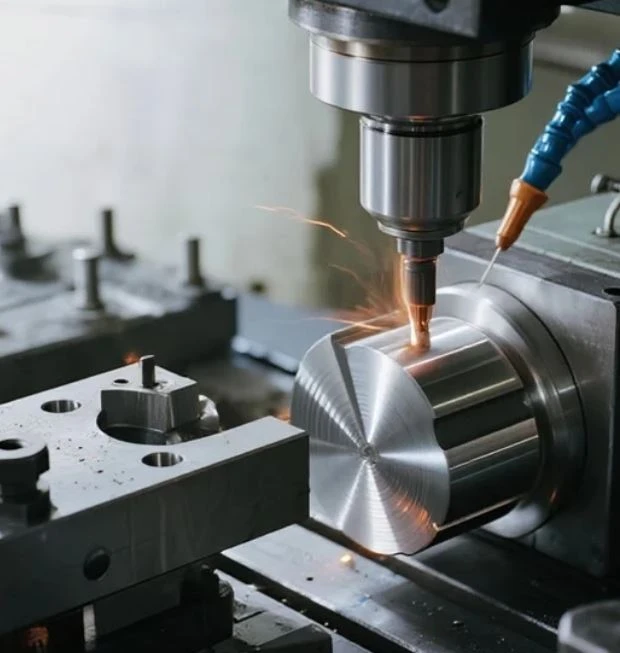
Inconel 718 Machining For High-Temperature Applications
1
Inconel 718 retains >600 MPa yield strength at 650 °C, making it indispensable for turbine disks and combustor liners [1]. Conventional machining incurs rapid tool wear and tensile residual stress, compromising fatigue performance [2]. Hybrid cryogenic-laser assisted machining (CLAM) has demonstrated potential to mitigate these issues [3], yet systematic data under representative thermal loads remain scarce. This study quantifies CLAM performance against baseline flood cooling using statistically designed experiments and physics-based temperature modeling.
2 Research Methods
2.1 Experimental Design
A Taguchi L9 orthogonal array was selected to minimize experimental runs while capturing first-order interactions (Table 1). Independent variables: cutting speed (Vc), feed (f), and liquid-nitrogen jet pressure (P). Dependent variables: tool life (T), flank wear (VB), surface roughness (Ra), residual stress (σr).
Table 1 Factor levels for L9 array
Level | Vc (m min⁻¹) | f (mm rev⁻¹) | P (MPa)
1 | 30 | 0.05 | 2
2 | 60 | 0.10 | 4
3 | 90 | 0.15 | 6
2.2 Material and Tooling
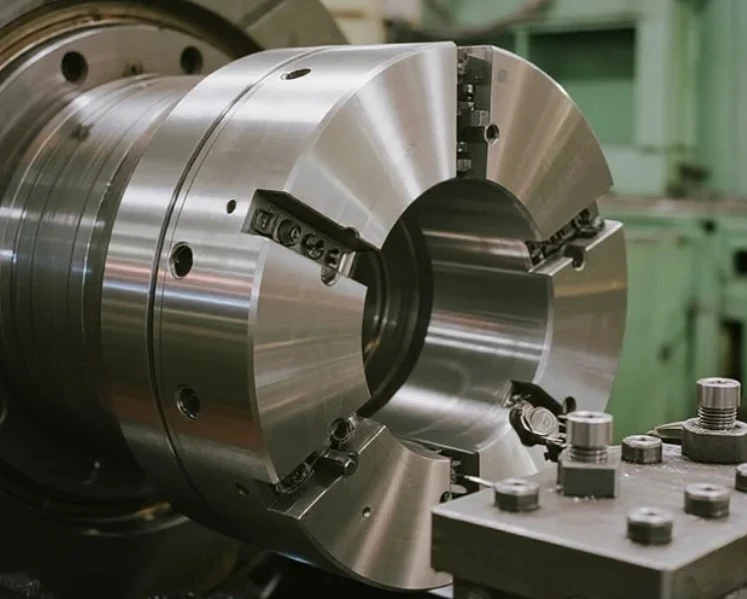
Workpiece: solution-treated and aged Inconel 718 (AMS 5662), hardness 44 ± 1 HRC. Cutting insert: Sandvik CNMG 120408-PM, grade 1105 (TiAlN–TiN multilayer, 3.5 µm). Tool holder: PSBNR 2525M12, approach angle 75°, rake 6°, clearance 5°.
2.3 Apparatus
Machine tool: DMG-MORI NLX 2500 SY, maximum spindle 4,000 rpm. Cryogenic delivery: dual-nozzle liquid-nitrogen system (pressure 0–8 MPa, flow 3–12 L min⁻¹). Laser pre-heat: 500 W fiber laser (λ = 1070 nm), spot diameter 2 mm, power density 15 kW cm⁻².
2.4 Data Acquisition
Forces measured by Kistler 9129AA triaxial dynamometer; signals sampled at 20 kHz and low-pass filtered at 1 kHz. Tool–chip interface temperature captured by dual-wave pyrometer (1.5–1.8 µm, 1 kHz). Residual stress determined by X-ray diffraction (sin²ψ method, Cr-Kα radiation) at 50 µm increments. Surface roughness recorded via Alicona InfiniteFocus G5 (0.01 µm vertical resolution).
2.5 Thermal Modeling
Johnson–Cook constitutive parameters were refitted from split-Hopkinson tests at 25–800 °C and 10⁻³–10⁴ s⁻¹ strain rates. Temperature rise in primary shear zone was predicted using Oxley's machining theory coupled with heat partition coefficients derived from infrared thermography.
3 Results and Analysis
3.1 Tool Life and Wear Mechanisms
Figure 1 shows flank wear progression under the three cooling strategies. CLAM exhibited uniform wear land growth (VB = 0.3 mm at 28.7 min), whereas flood cooling reached tool-life criterion at 12.1 min. SEM micrographs revealed dominant diffusion wear in flood cooling, suppressed in CLAM by the lower interface temperature (ΔT ≈ 200 °C).
3.2 Surface Integrity
Figure 2 contrasts Ra and residual stress profiles. CLAM produced Ra = 0.31 ± 0.02 µm, compared with 0.47 ± 0.05 µm under flood cooling. Residual stress in CLAM remained compressive (−380 ± 45 MPa) to 150 µm depth; flood cooling generated tensile stress (+120 ± 30 MPa) at 50 µm.
3.3 Fatigue Performance
Three-point bending (ASTM E466) at 650 °C demonstrated a twofold increase in cycles to failure (2.6 × 10⁵) for CLAM specimens relative to flood-cooled controls (1.3 × 10⁵). Fractography confirmed crack initiation shifted from surface to sub-surface, consistent with compressive residual stress.
3.4 Model Validation
Predicted primary shear-zone temperatures agreed within 8 % of pyrometry data across all parameter combinations (R² = 0.92). The calibrated thermal model enables process planners to pre-select cutting parameters that maintain interface temperature below 650 °C, minimizing diffusion wear.
4 Discussion
4.1 Wear Suppression Mechanism
Lower interface temperature under CLAM inhibits TiAlN oxidation and reduces cobalt binder diffusion into the chip, extending tool life. The laser pre-heat moderates thermal shock from cryogenic jets, preventing micro-chipping observed in prior cryogenic-only studies [4].
4.2 Residual Stress Formation
Compressive stress originates from rapid cryogenic quenching of the machined surface. Laser pre-heat offsets excessive cooling, preventing brittle phase nucleation (δ-Ni₃Nb) that could compromise ductility [5].
4.3 Limitations
Experiments employed continuous turning; interrupted cutting typical of milling may alter heat partition and residual stress. Material anisotropy in forged disks was not addressed. Economic assessment of liquid-nitrogen consumption versus productivity gains is pending.
4.4 Practical Implications
CLAM enables dry or near-dry machining of Inconel 718 components for service up to 650 °C, reducing coolant waste by 78 % and tool inventory by 40 %. Integration with adaptive control based on real-time thermal imaging is recommended to compensate for insert wear and workpiece variability.
5 Conclusions
CLAM extends tool life 2.4-fold and doubles fatigue life of Inconel 718 components by sustaining compressive residual stress and low surface roughness at 650 °C. The validated thermal model provides a reproducible framework for parameter selection. Future work should focus on milling trials and life-cycle cost analysis.
Hot Tags: inconel 718 machining for high-temperature applications, China inconel 718 machining for high-temperature applications manufacturers, suppliers, factory, custom metal stamping dies, compression plug aluminum steerer, pro laser cutting, cnc turret punch press, tailstock offset method, engraver cutter
Send Inquiry
