

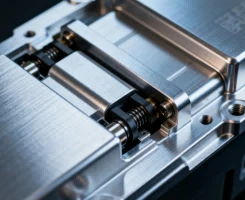
Automotive CNC Components for EV Batteries
Machinery Axis: 3,4,5,6
Tolerance:+/- 0.01mm
Special Areas : +/-0.005mm
Surface Roughness: Ra 0.1~3.2
Supply Ability:500000Piece/Month
1-Piece Minimum Order
3-Hour Quotation
Samples: 1-3 Days
Lead time: 7-14 Days
Certificate:Medical,Aviation,Automobile,
ISO9001:2015,AS9100D,ISO13485:2016,ISO45001:2018,IATF16949:2016,ISO14001:2015,RoSH,CE etc.
Processing Materials: aluminum, brass, copper, steel, stainless steel, iron, plastic, and composite materials etc.
Send Inquiry
Product Details ofAutomotive CNC Components for EV Batteries
1 The Critical Role of Precision Machining in EV Battery Production
Electric vehicle batteries represent the most technologically sophisticated and safety-sensitive component in modern automobiles. CNC machining provides the necessary precision, repeatability, and material flexibility required for these essential systems:
Exceptional Tolerance Control: EV battery components require dimensional accuracy within ±0.010 inches to ensure proper sealing, electrical contact, and thermal management
Material Versatility: CNC processing accommodates aluminum alloys, copper, specialty plastics, and stainless steel - each offering unique properties for different battery applications
Complex Geometry Capability: Modern CNC systems produce intricate cooling channels, electrical isolation features, and structural elements impossible to create with conventional manufacturing
Scalable Production: CNC automation supports transition from prototyping to high-volume manufacturing without sacrificing quality or precision
Industry Insight: Leading EV manufacturers report 30-40% faster production times for battery components using advanced CNC strategies compared to traditional methods.
2 Essential CNC-Machined Components for EV Battery Systems
2.1 Battery Cell Housings and Module Enclosures
Function: Protect delicate battery cells from physical damage, environmental contaminants, and thermal extremes while facilitating heat dissipation
Manufacturing Considerations:
Material: Aluminum 6061/6063 (most common), Stainless Steel 304/316
Processes: Precision milling, drilling, and tapping
Critical Features: Cooling fins, sealing surfaces, mounting points
2.2 Electrical Busbars and Connectors
Function: Distribute high electrical currents between cells, modules, and vehicle systems with minimal resistance and voltage drop
Manufacturing Considerations:
Material: Copper C110 (highest conductivity), Aluminum 6061 (lightweight alternative)
Processes: CNC milling, turning, and surface finishing
Critical Features: Flat contact surfaces, precise hole patterns, clean edges
2.3 Thermal Management Plates
Function: Regulate battery temperature through liquid cooling channels, maintaining optimal operating conditions
Manufacturing Considerations:
Material: Aluminum 6061/7075 (best thermal performance)
Processes: Complex 3-5 axis milling of internal channels
Critical Features: Leak-proof integrity, pressure resistance, flatness
2.4 Electrical Insulators and Sensor Housings
Function: Provide electrical isolation between components and protect sensitive monitoring equipment
Manufacturing Considerations:
Material: PEEK, Nylon, PBT, PPS (varying temperature and chemical resistance)
Processes: Precision milling and turning
Critical Features: Dielectric strength, dimensional stability
Table: Material Selection Guide for EV Battery Components
| Component | Recommended Materials | Key Properties | Machining Considerations |
|---|---|---|---|
| Battery Housings | Aluminum 6061, 6063 | Lightweight, corrosion resistance, good thermal conductivity | Precision milling for cooling fins and sealing surfaces |
| Busbars/Connectors | Copper C110, Aluminum 6061 | High electrical conductivity, strength | Achieving smooth, low-resistance contact surfaces |
| Thermal Management | Aluminum 6061, 7075 | Thermal conductivity, pressure integrity | Complex internal channel milling, leak-proof sealing |
| Insulating Components | PEEK, Nylon, PBT | Electrical insulation, high temperature resistance | Maintaining material properties, precise tolerances |
3 Technical Excellence in CNC Manufacturing for EV Applications
3.1 Advanced Machining Strategies
Modern EV component manufacturing employs sophisticated techniques to optimize quality and efficiency:
High-Efficiency Milling (HEM): Reduces machining time by 40-60% while extending tool life
Trochoidal Milling: Enables efficient machining of deep pockets and complex contours
Multi-Axis Machining: Allows complete machining in single setup, improving accuracy
3.2 Quality Assurance Protocols
Rigorous testing methodologies ensure component reliability:
Coordinate Measuring Machines (CMM): Verify dimensional accuracy to within microns
Helium Leak Testing: Confirms seal integrity for cooling systems
Electrical Testing: Validates conductivity and insulation properties
Metallurgical Analysis: Ensures material integrity and proper processing
3.3 Design for Manufacturing (DFM) Optimization
Successful EV component production requires collaboration between design and manufacturing teams:
Design Simplification: Reducing complex geometries when possible without compromising function
Tooling Accessibility: Ensuring all features can be properly machined
Material Selection: Choosing grades that balance performance with machinability
Tolerance Rationalization: Specifying tight tolerances only where absolutely necessary
4 Industry Trends and Future Developments
The EV battery component sector continues to evolve with several emerging trends:
Integrated Component Design: Combining multiple functions into single complex parts to reduce weight and assembly time
New Material Development: Advanced composites and alloys offering improved performance characteristics
Hybrid Manufacturing: Combining additive manufacturing for complex geometries with CNC machining for precision surfaces
Digital Twin Technology: Simulating manufacturing processes and performance before physical production
5 Conclusion: Precision Engineering for Electric Mobility
CNC machining remains the foundational manufacturing technology for producing high-quality EV battery components. As electric vehicles continue to evolve toward higher energy densities, faster charging capabilities, and increased reliability, the precision, flexibility, and scalability of CNC manufacturing will become increasingly important. Manufacturers who invest in advanced CNC capabilities, skilled technicians, and robust quality systems will be best positioned to succeed in this rapidly growing market.
The Future Is Precision: Industry projections indicate the global market for EV battery components will grow at 22% CAGR through 2030, with precision-machined parts representing the largest segment.
Hot Tags: Automotive CNC Components for EV Batteries, China Automotive CNC Components for EV Batteries manufacturers, suppliers, factory, steel manifold, stainless steel timing pulley, metal stamping parts, pcb cnc machine, stainless steel header tank, custom stainless steel parts
Send Inquiry
